

In today’s market, having compelling content and great ideas is not enough. You need a plan. Of course, a good communication plan takes time, usually involving the development of a customer journey, personas and an editorial plan. It’s time well invested though, ensuring your content hits the mark instead of going unnoticed.

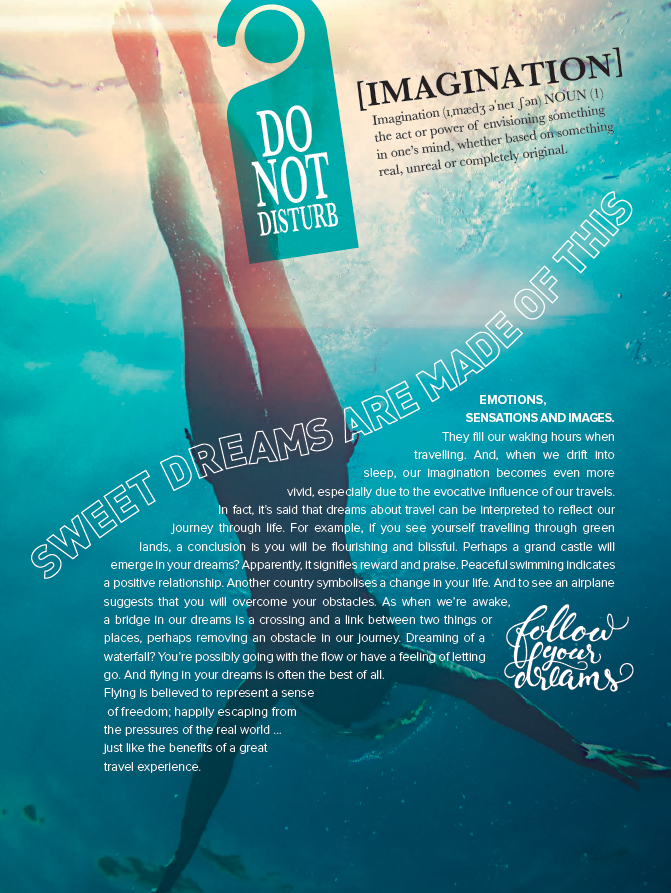
WHY MAGAZINE FOR WORLDHOTELS
Worldhotels provides its partner hotels with marketing that really gets under the skin of each persona, whether business traveler, city tripper or global backpacker. They do that by focusing on the “why” behind the choices they make, using those insights to shape the customer journey. steelecht collaborated with this travel specialist on the campaign planning, copywriting, design and layout of their “WHY” magazine, distributed for free in their hotels.
It all begins with a marketing strategy
Most of our customers already have an overarching marketing strategy. Our role is then to apply it to a specific outcome, e.g. an upcoming marketing campaign. Sometimes this requires revisiting the more general strategy and rethinking some of its basic assumptions.
For instance, what are the main goals of the planned campaign? There will be a different approach, obviously, if your aim is to generate more leads or simply to promote yourself as a thought leader. Which territory you are targeting will also requires a tailored approach.
Knowing your goals is only the beginning of campaign planning. Now comes the fun stuff! This is when we proverbially sit down together with you and roll up our sleeves. Here are a few of the questions we go through:
- What do you know about the market/territory/country you are focusing on?
- Who are your most important target groups there?
- Which persona could stand for each of them? (Did we lose you already? Read our blog article about personas!)
- How does each such persona find you?
- What are they looking for?
- What are their most pressing pain points?
- Can they easily discover your solutions to their problems?
- What is your competition doing in this market?
- What makes you unique?
- Do you have a funnel strategy?
- How much content is needed?
- Do you have an editorial plan?
These are just a few of the most salient points along the customer journey, which should be addressed by your campaign-specific marketing strategy.
Are you looking for more leads, more traffic, more sales or maybe more effective employer branding? These are just a few of the goals that campaign planning with steelecht can help you achieve
NRW/USA partnership year
NRW (North Rhine-Westphalia), Germany’s most populous state, decided to highlight their historical and political ties with the USA for one year of diplomatic, commercial and educational initiatives. The agency Urban Media Project partnered with steelecht to develop the concept for the year, including the tagline “A Perfect Match”. After winning the pitch, we first supported the project with marketing strategy services, such as campaign planning and the development of a content calendar. We then supplied English copywriting and transcreation services throughout the year, which actually spanned two years (from June 2023 to about September 2024).
The communication plan is your roadmap
Based on the insights from developing and fine tuning your marketing strategy, it’s time to work out your communication plan. Here are some of the typical activities involved:
- Researching your target market, ideally with professionals who already operate in it, or are very familiar with it
- Persona development, which can be based on market research or collecting anecdotal information from your local sales teams
- Assessing which content is required to achieve your goals and convert potential customers
- Analyzing relevant existing materials
- Understanding the most effective customer journey
- Researching keyphrases
- Performing a competitor analysis (what are they doing well, what persona pain points are they neglecting)
- Producing a content gap analysis (what you have vs. what you need)
- Mapping content to customer needs, pain points, questions, and the buying cycle
- Which communication channels will be the most effective for your marketing campaign, also considering costs and potential gains
- Development of an “editorial plan” or “content calendar”, including scheduling, milestones, priorities, responsibilities, channels, maintenance, etc.
What happens next?
Like all plans, your communication plan should be iterative and flexible. After all, marketing happens in the real world: goalposts change, priorities shift, a new manager is hired. Oh, and ideas evolve…
Yes, creativity is a messy business, which is exactly why a clear structure is so helpful. Thinking through all the steps helps you deliver the best results in all circumstances.
Here are some of the things your campaign planning should be taking into account:
CREATION
What kind of creative professionals will you need? What is their availability? Do they have back-ups? Who will be in charge of quality control?
PUBLISHING
Think about owned, paid and earned media. How can you make the best use of each of them? Your persona profiles will come in handy here.
PROMOTION
Even if your campaign is mostly for social media, it is recommended to use other channels to promote it, e.g. sending out emails asking people to repost, like or comment.
METRICS
You should always consider measuring the effectiveness of your publications. Daunted by data overkill? In light of your customer journey and funnel strategy, you may choose to place the focus on the most critical conversion points.
RESPONDING
Based on your collected metrics or target group feedback, revisit your marketing campaign and consider what could be improved, especially if further iterations are on the horizon.
Discoverable, sharable and actionable digital content should be at the center of every communication plan – with something for every key persona. Start campaign planning with steelecht today!


TRANSCREATION
At steelecht, all our translators are also writers. That means they not only speak more than one language very well, they are also highly skilled at producing quality copywriting. If corporate storytelling is important to you, steelecht’s experienced team of English and German copywriters will help you uphold your high standards in those languages – and every other language you communicate in.

WRITING & EDITING
When we write and edit texts at steelecht, our main goal is to help support your business objectives. That’s why we work hard to find the best words to capture your target group’s attention – and win over their hearts. We also love to please Google algorithms, which recognize and reward quality copywriting. Learn more about our writing services in English, German and other languages.